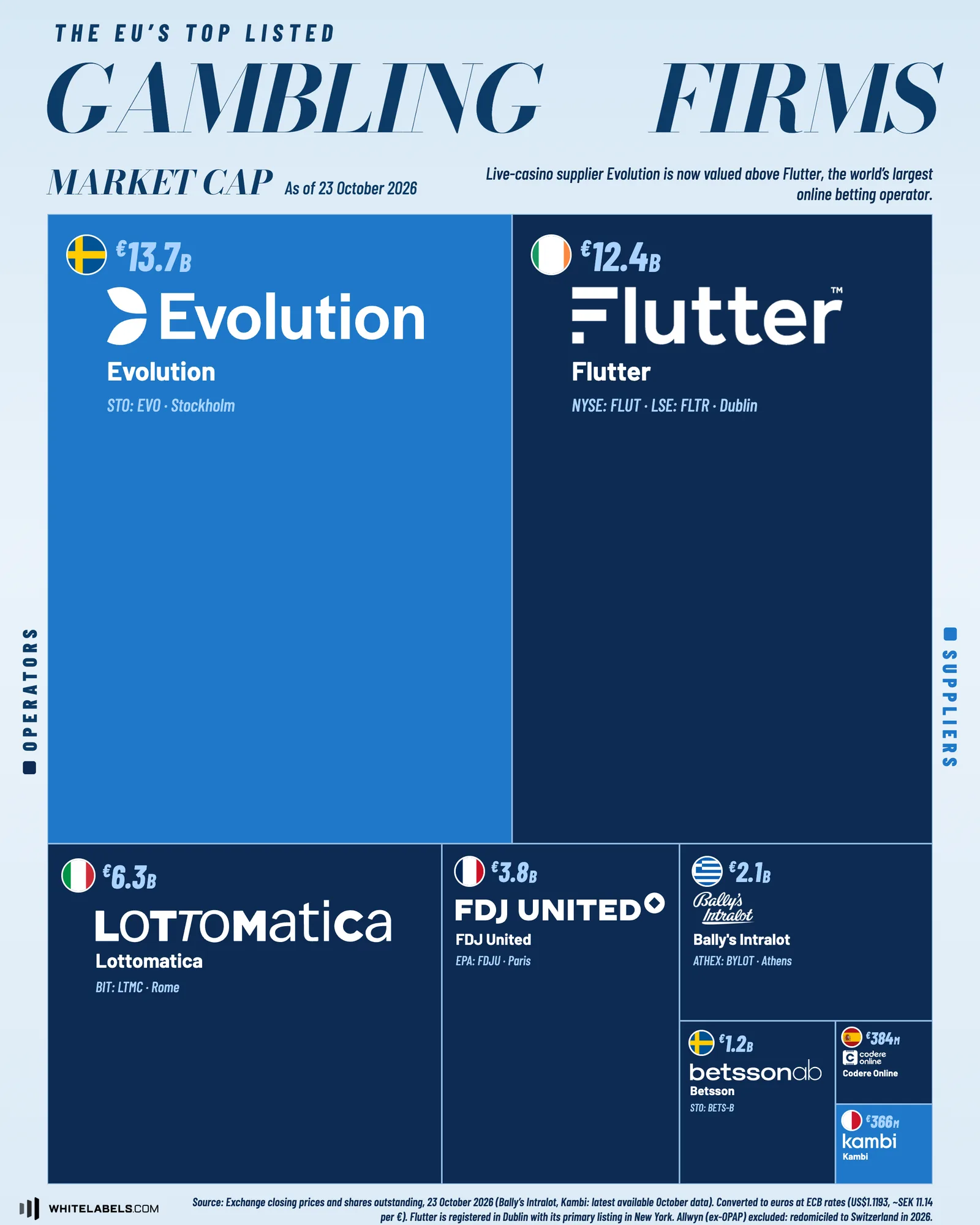
Evolution, a Swedish company that sells live casino tables to other brands, is now the biggest listed gambling company in the EU. On 23 October 2026 it was worth €13.7 billion, ahead of Flutter at €12.4 billion. Flutter owns FanDuel, Paddy Power and Betfair, and it earns about 7 times more revenue.
This ranking counts the 8 gambling companies that are headquartered in the EU and listed on a stock exchange. Together they are worth about €40.3 billion.
Which EU gambling companies are worth the most?
Evolution is first at €13.7 billion, and the top two are worth more than the other six combined. Here is the full list, using exchange closes from 23 October 2026.
| Rank | Company | HQ | Type | Market cap | 2025 revenue |
|---|---|---|---|---|---|
| 1 | Evolution | Sweden | Supplier | €13.7B | €2.07B |
| 2 | Flutter Entertainment | Ireland | Operator | €12.4B | €14.5B |
| 3 | Lottomatica | Italy | Operator | €6.3B | €2.26B |
| 4 | FDJ United | France | Operator | €3.8B | €3.68B |
| 5 | Bally's Intralot | Greece | Operator and lottery tech | €2.1B | €0.52B |
| 6 | Betsson | Sweden | Operator | €1.2B | €1.20B |
| 7 | Codere Online | Spain | Operator | €384M | €210M |
| 8 | Kambi | Malta | Supplier | €366M | €162M |
Why is a supplier worth more than the biggest online betting operator?
Because investors pay far more for each euro of Evolution's revenue than for each euro of Flutter's. Evolution is valued at about €6.60 per €1 of 2025 revenue, and Flutter at about €0.86.
Evolution runs no casino brand of its own. It builds and runs live dealer studios and sells the stream to operators, so one set of tables serves many brands. Flutter is the opposite: it sells to players directly through its own brands, and its revenue is about 7 times larger at €14.5 billion. Evolution is not the bigger business. Investors simply pay more for each euro it earns.
The same pattern shows up across the whole list. Evolution and Kambi, the two B2B suppliers, hold about 35% of the combined market cap but only about 9% of the combined revenue. Our worldwide ranking of public iGaming companies shows suppliers sitting high on that list too.
What happened to Flutter's market value?
It fell by roughly 70% in under two years. Flutter's market cap was about $48 billion in December 2024 and is about $13.9 billion now.
That is the main reason Evolution moved ahead. Flutter's revenue kept growing, with €14.5 billion in 2025, but its share price did not follow. Our September 2026 ranking of the biggest public iGaming companies put Flutter at an estimated $18.1 billion, a rounded figure from before this latest snapshot. For the history behind Flutter's size, see how it bought The Stars Group and how Paddy Power and Betfair merged.
Flutter is on this list because it is registered in Dublin, Ireland. Its main listing and operating headquarters are in New York, and it also trades in London.
How much of the total do the top two hold?
About 65%. Evolution is 34% of the €40.3 billion, Flutter is 31%, and the other six companies share the remaining 35%.
The gap below them is large. Lottomatica, in third place, is worth €6.3 billion, about half of Flutter. The last three companies on the list, Betsson, Codere Online and Kambi, are each worth €1.2 billion or less. Codere Online and Kambi together, at about €750 million, are worth less than Betsson alone.
Are FDJ United and Lottomatica really gambling tech companies?
They are gambling groups, and they are not pure iGaming. FDJ United runs the French lottery and sports betting and, after its purchase of Kindred, also runs online brands including Unibet. Most of its €3.68 billion in revenue is still lottery. Lottomatica in Italy mixes online casino and betting with physical gaming halls.
Bally's Intralot is a mix too. It is an operator and a lottery technology supplier, and 58% of it is owned by Bally's Corp.
What do the P/E ratios of these companies look like?
Two of the eight companies lose money, and one of the profitable ones trades at almost 160 times its earnings. The P/E ratio is the market cap divided by the last twelve months of net profit, so it tells you how many euros investors pay for each euro the company earned.

A loss means there is no useful trailing P/E, so the chart marks those two as "n/m", not meaningful. Forward P/E uses analyst estimates of next year's profit, and forecasts can be wrong. Flutter's is about 14.
How can Flutter be worth €12.4 billion and still lose money?
Because the market is valuing Flutter on the profit it is expected to make, not on the loss it reported. An analyst would start by splitting the loss into what is accounting and what is real.
The reported numbers are confirmed in Flutter's own filings. It lost $407 million in 2025, against a $162 million profit in 2024, after a non-cash charge of $556 million linked to India's ban on real-money online gaming. In the second quarter of 2026 it lost $296 million (the part for Flutter shareholders was $274 million, or $1.57 per share), against a $37 million profit a year earlier (Flutter, SEC filing).
Part of that quarter's loss is financing and accounting rather than weak betting. Interest expense rose $52 million to $162 million after Flutter paid for Snai in Italy, Betnacional in Brazil and Boyd's 5% stake in FanDuel. Depreciation and amortisation rose to $399 million, and the company booked $95 million of historical tax provisions, including an Indian goods and services tax item and a US sales and use tax accrual.
Another part is real. US adjusted EBITDA fell $281 million to $119 million in the quarter, with an unfavourable run of US sports results cited, and higher UK gaming taxes and heavy spending on a new prediction-markets business also cut earnings. Flutter lowered its full-year guidance after the quarter.
So why is the market cap still large? Flutter's trailing revenue is about $17.2 billion, so the company is valued at less than one times its sales. The forward P/E of about 14 says analysts expect profit to come back, and that is roughly where Evolution's forward P/E sits (about 12). If the recovery does not happen, today's value is too high, and that is the risk the share price carries. This is an analysis of public numbers, not a prediction.
Is Bally's Intralot really losing money?
Yes, at the reported level, though the picture changes with how you count. Bally's Intralot posted a loss after tax of €12.7 million for the first half of 2026, against a €2.9 million profit in the same period of 2025 (Gaming Intelligence). One earnings call transcript gives a larger loss of €20.7 million that does not match its own pre-tax figure, so we use the €12.7 million number. Over twelve months, StockAnalysis shows a loss of about €79 million.
The cause is mostly the cost of the deal that built the group. Net interest expense was €69.6 million and depreciation and amortisation was €85.6 million in the half, against adjusted EBITDA of €184.8 million. Revenue more than doubled to €544.2 million because the acquired businesses now count. One report says that on a pro forma basis, which treats those businesses as owned all along, profit after tax was €122 million. That is a different measure from the reported loss, and you should not mix the two.
The forward P/E of about 66 shows that analysts expect only a small profit next year, so even a recovery would leave the shares expensive on earnings.
Why does FDJ United have a P/E ratio of almost 160?
Because the earnings in the denominator are close to zero. FDJ United's market cap is about €3.8 billion, and its net income over the last twelve months is only about €24 million, which gives a trailing P/E near 160.
The reason is the Kindred deal. FDJ bought Kindred, the owner of Unibet, for about €2.45 billion in 2024. Buying a company this way creates large accounting charges. FDJ's 2025 net income fell 56% to €175.9 million, and its first half of 2026 was a net loss of €16 million, against a €136 million profit a year earlier. A €135 million impairment in the online division added to the hit.
Strip those charges out and the picture changes. Removing the one-off charges alone brings the P/E to about 23, as the chart shows. FDJ's own adjusted net income, which also excludes the purchase price accounting, was €486.9 million for 2025, and on that figure the market cap is only about 8 times earnings. The forward P/E of about 8.6 points the same way. Which number is fair depends on how many of the charges you think will come back, but either way an analyst would call the 160 a distortion from the deal rather than a sign that investors expect huge growth.
The trade-off is that adjusted profit is not cash in the bank for every charge. Some of the impairment says Kindred is worth less than FDJ paid, and management is reportedly reviewing online markets and possible disposals. That is the real question behind the number.
Why is Evolution's P/E only about 14?
Because Evolution turns about half of its revenue into net profit. Its trailing net income is about SEK 11.9 billion on revenue of about SEK 23.5 billion, a margin of roughly 51%. That is why a company valued at €6.60 per €1 of revenue still trades at a P/E of 14.4, while Kambi and Codere Online, with thin profits, sit near 40.
How much is each euro of revenue worth?
It depends a lot on the company, from less than €1 at Flutter to more than €6 at Evolution. Move the slider to see each company's share of the group, its market cap per €1 of 2025 revenue and its P/E ratio.
What is each euro of revenue worth?
Move the slider from the smallest company to the biggest. The tool divides each market cap by its 2025 revenue, shows its share of the €40.3 billion group, and adds its trailing P/E ratio.
Market cap
€366 million
Share of the 8-company total
2025 revenue
€162 million
Market cap per €1 of revenue
€2.26
Trailing P/E ratio
38.3
Compared with Evolution
Evolution is worth about 37 times as much as Kambi.
Market caps are exchange closes on 23 October 2026 (Kambi from 19 October, Bally's Intralot from the latest October data). Revenue is FY2025 as reported, and Bally's Intralot uses its reported €0.52 billion, not the €1.09 billion pro forma figure. The P/E ratios are trailing figures for 16 to 23 October 2026 and are not guaranteed to be correct. This is a reference tool, not financial or investment advice.
Which gambling companies were left out?
Several names you might expect are missing, because they are headquartered outside the EU or are no longer listed.
- Allwyn (formerly OPAP, listed in Athens as ALWN) moved its legal home to Switzerland in 2026. Its market cap was about €5 billion when it listed in March 2026.
- Entain, evoke, Playtech and Rank are based in the UK or the Isle of Man.
- Kindred no longer exists as a listed company, since FDJ bought it and delisted it in 2024.
Entain and Playtech appear in our worldwide ranking of the biggest public iGaming companies, which also includes the US and Australian names.
What does this ranking mean for anyone building a casino?
It shows where investors think the profit sits: in the technology that many operators share, more than in running one consumer brand. Evolution's lead over Flutter is the clearest case, and the two suppliers on the list are valued at a much higher multiple than the operators.
If you want to launch your own brand without building that technology yourself, a white label casino platform gives you games, payments and a ready site from day one. You can see what that costs on the pricing page. For more on how the biggest names got there, read how Evolution bought NetEnt next.
Disclaimer: this is not financial advice, and none of the data in this article is guaranteed to be correct. Do your own research and check company filings before making any decision.
Key takeaways
- Evolution is worth €13.7 billion, more than Flutter at €12.4 billion, even though Flutter's 2025 revenue of €14.5 billion was about 7 times Evolution's €2.07 billion.
- Evolution and Flutter together make up about 65% of the €40.3 billion combined value of the eight EU-headquartered listed gambling companies in this ranking.
- The two B2B suppliers on the list, Evolution and Kambi, hold about 35% of the combined market cap but only about 9% of the combined revenue.
- Flutter's market cap fell from about $48 billion in December 2024 to about $13.9 billion in October 2026, a drop of roughly 70%.
- FDJ United and Lottomatica are large gambling groups with big online arms, not pure iGaming companies, and much of FDJ's revenue still comes from lottery.
- Flutter and Bally's Intralot both reported net losses over the last twelve months, so neither has a trailing P/E ratio, even though Flutter is the second biggest company on the list.
- FDJ United has the highest trailing P/E on the list at about 159, because acquisition accounting cut its reported net income to about €24 million, while its forward P/E is about 8.6 and its P/E without one-off charges is about 23.
- Evolution trades at a trailing P/E of about 14.4 despite its high price per euro of revenue, because it keeps roughly half of each krona of revenue as net profit.
- Allwyn is left out because it moved its legal home to Switzerland in 2026, and Entain, evoke, Playtech and Rank are left out because they are based in the UK or the Isle of Man.
Sources and further reading
- Flutter Entertainment Q2 2026 earnings release (SEC Form 8-K, Exhibit 99.1)
- Flutter reports Q4 and FY25 results (iGaming Future)
- Bally's Intralot posts €12.7 million loss for H1 2026 (Gaming Intelligence)
- Higher tax hits revenue at FDJ United despite Kindred integration (iGaming Business)
- StockAnalysis (S&P Global), P/E ratios and trailing net income
- GuruFocus, P/E ratios
- Yahoo Finance, share prices and market caps
- StockAnalysis, market caps and shares outstanding
- Morningstar, share prices and market caps
- Investing.com, share prices
- ECB euro foreign exchange reference rates, 23 October 2026