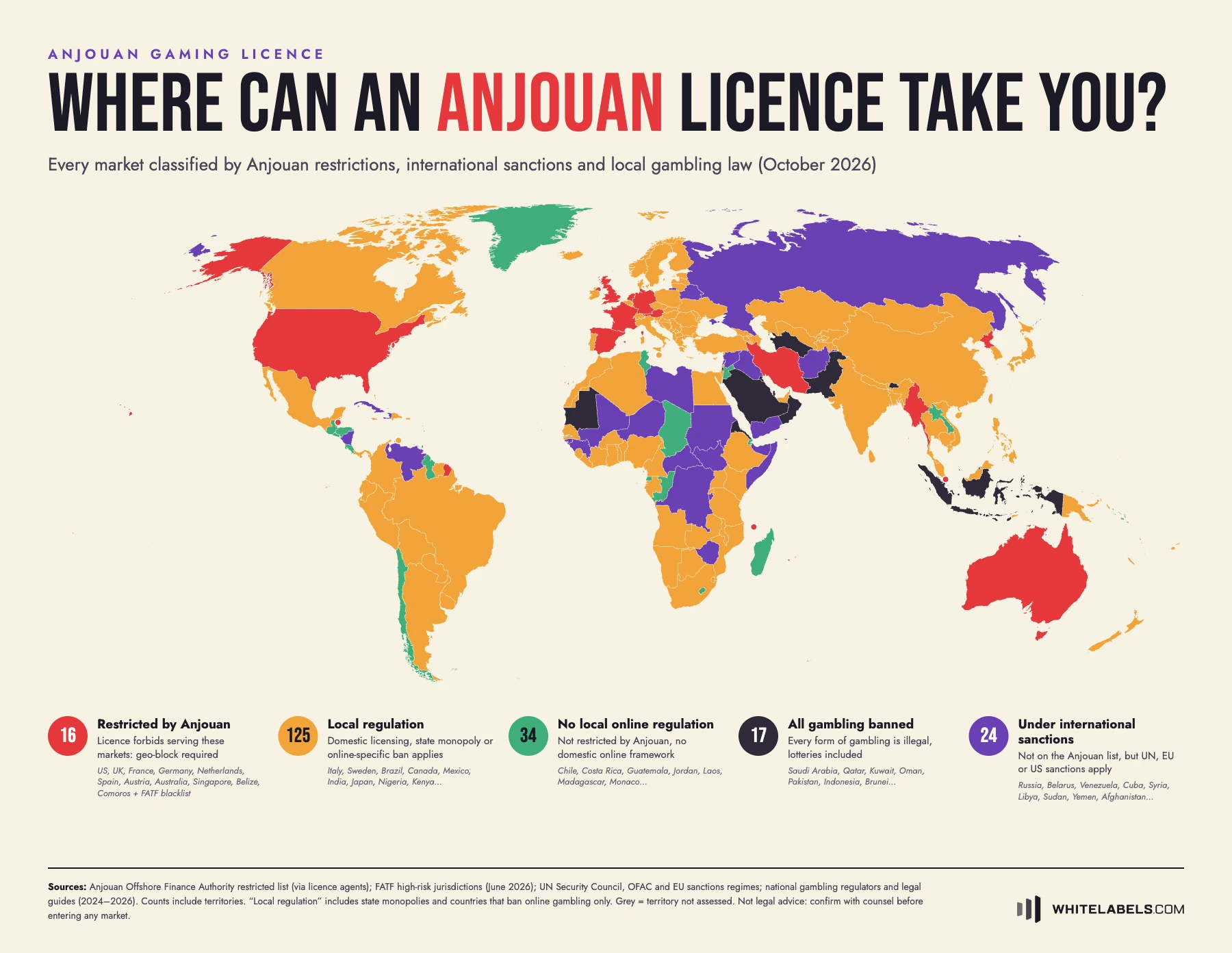
An Anjouan gaming license does not cover the whole world. The license itself bans 16 markets on our map, including the United States, the United Kingdom, France and Germany. Many other markets are closed in practice, because of sanctions, total gambling bans or local licensing rules. Only 34 markets have no local online rules. This guide shows the map, lists every market by category, and lets you check any country.
Which countries can an Anjouan gaming license serve?
Only the green markets are open to an Anjouan-only operator, and there are 34 of them. Every other market falls into one of four groups with a restriction, a ban, sanctions or a local license requirement. The table shows all five groups, with the number of markets on the map.
| Map color | Category | Markets on the map | What it means for you |
|---|---|---|---|
| Red | Restricted by Anjouan | 16 | The license forbids serving these markets, so a geo-block is required |
| Orange | Local regulation | 125 | Domestic licensing, a state monopoly, or a ban on online gambling only |
| Green | No local online regulation | 34 | Not restricted by Anjouan, and no domestic online framework |
| Black | All gambling banned | 17 | Every form of gambling is illegal, lotteries included |
| Purple | Under international sanctions | 24 | Not on the Anjouan list, but UN, EU or US sanctions apply |
The counts include territories, so a list below can name fewer markets than its count. For the license itself, including fees and renewal, read our Anjouan gaming license cost breakdown.
How do you read the map?
Each country is colored by the strictest rule that applies to it. Red markets are banned by the Anjouan license itself. Purple markets are under international sanctions, so banks and payment providers usually block them. Black markets ban all gambling. Orange markets have their own gambling laws, so you need a local license or must stay out. Green markets have no local online rules, which makes them the most open for an Anjouan operator.
When a country fits more than one category, the map shows the strictest one. The order is: restricted, sanctioned, banned, local regulation, no local regulation. Russia, for example, is shown as sanctioned. Territories follow their parent country, so French Guiana and French St. Martin follow France, and Sint Eustatius follows the Netherlands.
Which markets does the Anjouan license restrict?
The restricted list covers 16 markets on the map, led by the United States, the United Kingdom, France and Germany. These are the markets the license forbids you to serve. Serving them means a geo-block from day one, with IP blocking and payment blocking in place.
| Market | Notes |
|---|---|
| United States | Restricted by the license |
| United Kingdom | Restricted by the license |
| France | Includes French Guiana and French St. Martin |
| Germany | Restricted by the license |
| Netherlands | Includes Sint Eustatius |
| Spain | Restricted by the license |
| Austria | Restricted by the license |
| Australia | Restricted by the license |
| Singapore | Restricted by the license |
| Belize | Restricted by the license |
| Comoros | The home country of the license |
| Iran, North Korea, Myanmar | On the FATF call for action blacklist (June 2026) |
The FATF blacklist is not fixed. It updates three times a year, so the next update may change this list.
Which markets are under international sanctions?
These markets are not on the Anjouan list, but they are off limits in practice. A market lands here when the UN, the US Treasury (OFAC) or the EU sanctions that country. Banks and payment providers usually block these markets, so payments are hard or impossible.
Narrow listings of a few individuals do not count. We left out China and Hong Kong, Türkiye, Bosnia, Guatemala, Tunisia, Ukraine and Moldova for that reason.
| Afghanistan | Belarus | Burundi | Central African Republic |
| Cuba | DR Congo | Guinea | Guinea-Bissau |
| Haiti | Iraq | Lebanon | Libya |
| Mali | Nicaragua | Niger | Russia |
| Somalia | South Sudan | Sudan | Syria |
| Venezuela | Yemen | Zimbabwe |
Which countries ban all gambling?
In these markets, every form of gambling is illegal, lotteries included. Several are in the Gulf. With every form of gambling illegal, there is no legal route for an operator.
| Bahrain | Bhutan | Brunei | Cayman Islands |
| Eritrea | Indonesia | Kuwait | Maldives |
| Marshall Islands | Mauritania | Oman | Pakistan |
| Palestine | Qatar | Saudi Arabia | Turkmenistan |
| Vatican City |
Which markets need a local license?
Local regulation is the biggest group on the map. These markets have an online licensing system or a state online monopoly. Some ban online gambling while allowing other forms. An offshore license does not cover them.
This group includes most large markets, such as Italy, Sweden, Brazil, Canada, Mexico, India, Japan, Nigeria and Kenya. The practical choice is to get a local license or stay out. Passive traffic from players who find you without local advertising may be defensible. Marketing into these markets adds risk, so think it through before any campaign goes live.
| Albania | Algeria | Angola | Antigua and Barbuda | Argentina |
| Armenia | Aruba | Azerbaijan | Bahamas | Bangladesh |
| Belgium | Benin | Bolivia | Bosnia and Herzegovina | Botswana |
| Brazil | Bulgaria | Burkina Faso | Cabo Verde | Cambodia |
| Cameroon | Canada | China | Colombia | Croatia |
| Curaçao | Cyprus | Czechia | Côte d'Ivoire | Denmark |
| Dominican Republic | Ecuador | Egypt | Estonia | Eswatini |
| Ethiopia | Fiji | Finland | French Polynesia | Gabon |
| Georgia | Ghana | Greece | Guernsey | Hong Kong |
| Hungary | Iceland | India | Ireland | Isle of Man |
| Israel | Italy | Jamaica | Japan | Jersey |
| Kazakhstan | Kenya | Kosovo | Kyrgyzstan | Latvia |
| Liberia | Liechtenstein | Lithuania | Luxembourg | Macau |
| Malawi | Malaysia | Malta | Mauritius | Mexico |
| Moldova | Mongolia | Montenegro | Morocco | Mozambique |
| Namibia | Nepal | New Caledonia | New Zealand | Nigeria |
| North Macedonia | Norway | Palau | Panama | Papua New Guinea |
| Paraguay | Peru | Philippines | Poland | Portugal |
| Puerto Rico | Romania | Rwanda | Saint Kitts and Nevis | Samoa |
| Senegal | Serbia | Seychelles | Sierra Leone | Slovakia |
| Slovenia | South Africa | South Korea | Sri Lanka | Suriname |
| Sweden | Switzerland | Taiwan | Tajikistan | Tanzania |
| Thailand | Timor-Leste | Togo | Türkiye | Uganda |
| Ukraine | United Arab Emirates | Uruguay | Uzbekistan | Vanuatu |
| Vietnam | Western Sahara | Zambia | Åland |
Nineteen of these markets ban online gambling outright, while other forms stay legal. An offshore license gives you no cover there either.
| Algeria | Bangladesh | Bolivia | Cambodia |
| China | Egypt | Ethiopia | Fiji |
| French Polynesia | India | Kosovo | Liechtenstein |
| Malaysia | Mongolia | Namibia | Nepal |
| New Caledonia | Tajikistan | Timor-Leste |
Which markets have no local online rules?
These 34 markets have no specific online gambling framework, and Anjouan does not restrict them. Gambling may be legal offline, but there is no online law. This is the most open group for an Anjouan operator, and it is a short list.
| Andorra | Barbados | Bermuda | Chad |
| Chile | Congo (Republic) | Costa Rica | Djibouti |
| Dominica | El Salvador | Equatorial Guinea | Gambia |
| Greenland | Grenada | Guatemala | Guyana |
| Honduras | Jordan | Kiribati | Laos |
| Lesotho | Madagascar | Micronesia | Monaco |
| Nauru | Saint Lucia | Saint Vincent and the Grenadines | San Marino |
| Sint Maarten | Solomon Islands | São Tomé and Príncipe | Tonga |
| Trinidad and Tobago | Tunisia |
Open does not mean easy. Several of these markets are small, and payment options can be thin. A few are changing their rules, as the next section shows.
Which group is your market in?
Type a country or territory. The tool shows its color on the map and what it means for an Anjouan operator.
Result
Pick a market to see its group.
Based on the October 2026 classification in this article. Information only, not legal advice. Confirm with counsel and the regulator before you enter any market.
Which rule changes are coming?
A few markets are about to move between groups. These are the changes we are watching, as of October 2026.
| Market or list | Change | What it means |
|---|---|---|
| Trinidad and Tobago | Online licensing starts on 1 January 2027 | Moves from no local regulation to local regulation |
| Chile | The Senate approved an online gambling bill in general in September 2026 | Not yet law, so Chile stays green for now |
| Finland | Opens a licensed online market in 2027 | Already shown as local regulation |
| FATF blacklist | Updated three times a year | The next update may change the restricted list |
Re-check your market list every quarter and after each FATF update. Check with the regulator in each country, because a status can change before a list like this one catches up.
How did we classify each market?
We placed every market in one category, using this priority: restricted, sanctioned, banned, local regulation, no local regulation. A market sits in the first category it meets.
- Restricted by Anjouan. The market is on the Anjouan restricted list or the FATF call for action blacklist of June 2026. We use the extended Anjouan list that licensing agents use.
- Under international sanctions. The UN Security Council, the US Treasury (OFAC) or the EU runs a sanctions regime for the country.
- All gambling banned. Every form of gambling is illegal, lotteries included.
- Local regulation. The country has an online licensing system or a state online monopoly. Some ban online gambling while allowing other forms.
- No local online regulation. Gambling may be legal offline, but there is no specific online framework.
Our sources are the Anjouan Gaming restricted list as used by licensing agents and the FATF blacklist. We also used UN Security Council, OFAC and EU sanctions regimes, national regulators and legal guides from 2024 to 2026.
What does this mean if you want to launch with an Anjouan license?
The license is a good fit for a short list of markets and a poor fit for the biggest ones. If your plan depends on the US, Europe or a large local-license market, Anjouan alone is not enough. Pick your target markets first, then pick the license.
Our Anjouan gaming license cost guide covers the fees and the application. To compare options, read the Curacao license cost, the Malta license cost and the five licenses with the lowest requirements. To see which markets earn the most online, read the biggest iGaming markets by GGR.
To skip the license hunt, Whitelabels.com lets you launch a white label casino without your own license to start. See the pricing page and the options for local currencies and crypto. They matter as much as the license in each market.
Key takeaways
- The Anjouan license itself restricts 16 markets on the map, including the United States, United Kingdom, France, Germany, the Netherlands, Spain, Austria and Australia.
- Red is not the only no-go zone. Markets under international sanctions and markets that ban all gambling are off limits in practice too.
- Local regulation is the biggest group, with 125 markets on the map. An offshore license does not cover them, so you need a local license or must stay out.
- Only 34 markets have no local online gambling rules and no Anjouan restriction. That short list is the realistic target for an Anjouan-only operator.
- "When a country fits more than one category, the map shows the strictest rule, in this order: restricted, sanctioned, banned, local regulation, no local regulation."
- Laws change. The FATF list updates three times a year, so re-check your market list every quarter.