
David Fishman taught math for a living, not poker. In 2010, PokerStars staked him $100,000 to sit down against professionals like Phil Hellmuth on its televised cash game show, The Big Game. He walked away with $129,600 in profit, and he built most of that edge by knowing exactly when to fold hands that most amateurs would have played straight into the ground.
What was PokerStars' The Big Game, and who was the Loose Cannon?
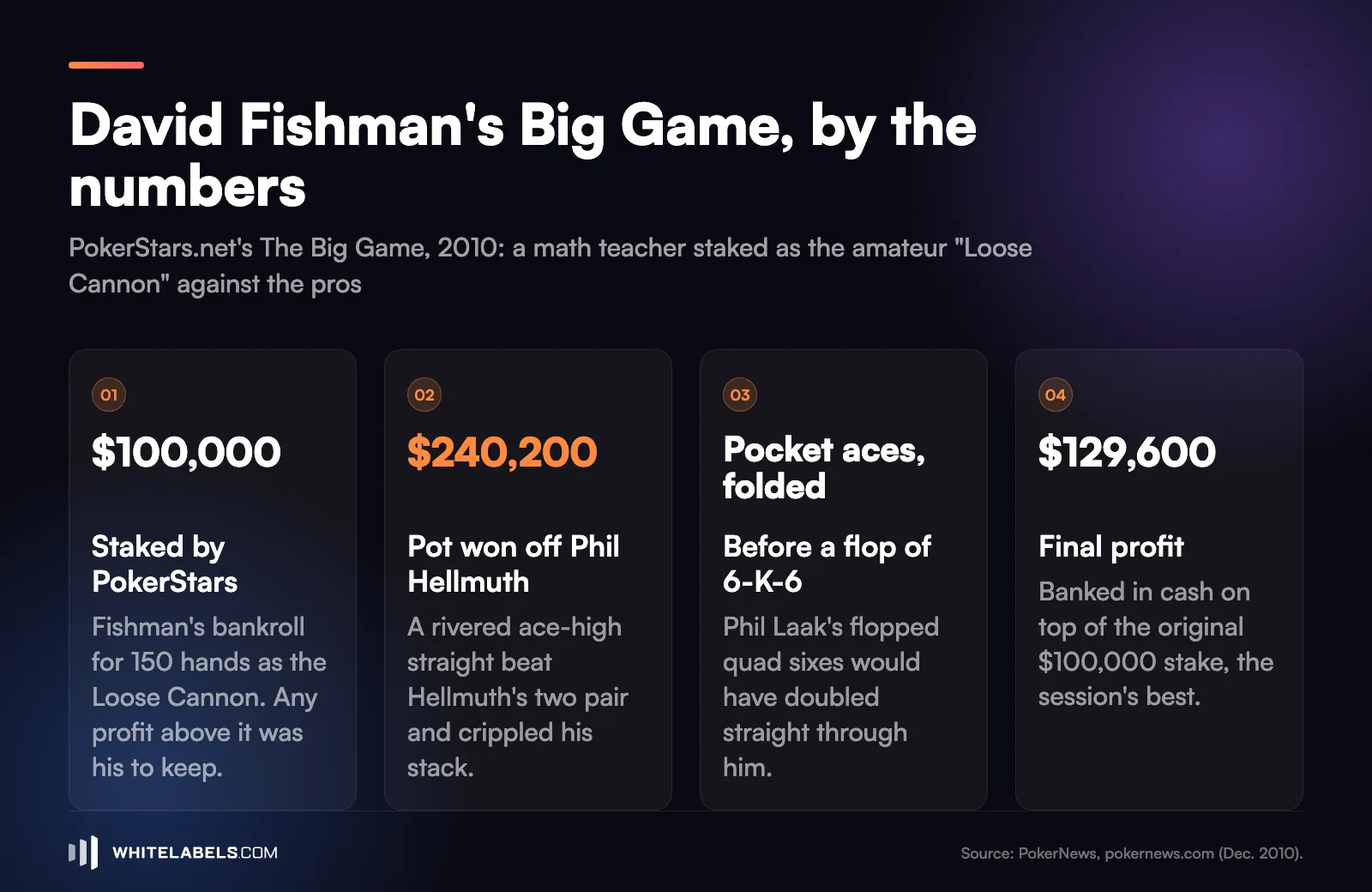
The Big Game was a televised cash game show that PokerStars ran on Fox from 2010 to 2011, pitting five professional poker players against one amateur each week. That amateur was called the Loose Cannon. PokerStars staked the Loose Cannon $100,000 and let them play 150 hands of no-limit hold'em, and any money they won above that stake was theirs to keep. The professionals bought in for at least $100,000 each and could rebuy up to $500,000 if they busted, so the pots got large fast. The season's top-earning Loose Cannon also won a $50,000 North American Poker Tour passport, covering entry fees and travel for future tournaments.
Who is David Fishman?
Fishman was a 35-year-old math teacher and cancer survivor from Tempe, Arizona, when he earned a seat as the Week 10 Loose Cannon. He had qualified through PokerStars' online satellites rather than through any professional poker background. The table he sat down at for that episode included Phil Hellmuth, Phil Laak, David Williams, and Bill Perkins, a lineup most amateurs would find intimidating before a single card was dealt.
What happened when David Fishman played Phil Hellmuth?
Fishman won a $240,200 pot off Phil Hellmuth by staying patient with a drawing hand instead of giving up on it early. Hellmuth raised preflop holding ace-five, and Fishman called on the button holding king-queen. The flop and turn missed him outright, leaving a board of two clubs, a jack, an ace, and a five, while Hellmuth had already made two pair with his own ace and five. Then the ten of hearts hit on the river, completing an ace-high straight for Fishman that Hellmuth never saw coming. Hellmuth bet into him, Fishman paused as if he wasn't sure what to do, then moved all in. Hellmuth called and lost, and his own stack dropped to around $15,300.
Why did David Fishman fold pocket aces and pocket kings?
He folded them because protecting the profit he had already built mattered more than proving he held the best hand every single time. Later in the session, Fishman picked up pocket aces in the small blind. Phil Laak raised with pocket sixes, another player called with pocket fours, and Fishman let his aces go rather than get tangled in a multi-way pot. The flop came six-king-six, giving Laak flopped quad sixes. Had Fishman stayed in, it could have cost him most of what he had built up that night. A few hands later he picked up pocket kings, watched a raise and a re-raise develop behind him, and folded those too. A queen flopped on that hand, which would have hurt him had he called.
That kind of restraint is really just expected value thinking applied under pressure. Folding a strong hand isn't about being scared of losing. It's about recognizing the moment when the math no longer favors sticking around, and Fishman, a math teacher by trade, kept making that read all night.
Do you know David Fishman's story?
Answer 5 questions to see how solid your grasp of this story really is. Nothing is sent anywhere, this runs in your browser.
How much money did David Fishman walk away with?
Fishman finished his 150 hands with $129,600 in profit on top of his original $100,000 stake, more than any Loose Cannon had earned on the show up to that point in the season. He called his wife right after the session to tell her he was coming home with life-changing money for their family. His total held the season record for weeks, until Bob Ferdinand, a Boston bus driver known on the show as Bobby the Bus, beat it with $181,500 in Week 12 and won that season's $50,000 NAPT passport instead.
Fishman's episode aired the same year PokerStars was still run by Mark Scheinberg and his father Isai, before the 2011 Black Friday crackdown reshaped the entire US online poker market. The Big Game itself did not survive that shift either. PokerStars pulled it off the air in 2011 and did not bring it back in any form until 2024.
The bottom line
David Fishman's night on The Big Game is really a lesson in discipline dressed up as a poker story. He built a six-figure profit by playing a drawing hand out to the river against Phil Hellmuth, then protected all of it by folding two hands most players would have played to the end. A math teacher from Tempe, Arizona out-thought a table of professionals for one night, and he did it with patience rather than luck alone.
If a single hand of televised poker making six figures sounds appealing, building the platform underneath the game is a different kind of bet, and a steadier one. See what it costs to launch a white label casino today, or check current pricing if the business behind the cards is the part that interests you.
Key takeaways
- David Fishman, a math teacher and cancer survivor from Tempe, Arizona, played as the amateur "Loose Cannon" in Week 10 of PokerStars.net's The Big Game in 2010, staked $100,000 to play 150 hands against a table of professionals.
- He won a $240,200 pot off Phil Hellmuth after rivering an ace-high straight, dropping Hellmuth's own stack to around $15,300.
- Fishman later folded pocket aces before a flop of six-king-six that would have given Phil Laak flopped quad sixes, then folded pocket kings into a raise and a re-raise rather than risk his stack.
- He finished the session with $129,600 in profit above his original $100,000 stake, the best total of any Loose Cannon on the show up to that point in the season.
- Bob Ferdinand, a former Boston bus driver known on the show as "Bobby the Bus," later beat Fishman's total with $181,500 in Week 12 and won that season's $50,000 NAPT passport.


