

A wagering requirement is the multiplier a casino attaches to a bonus that decides how much money you have to bet before any of that bonus becomes yours to withdraw. It also goes by playthrough requirement or rollover requirement, depending on the operator. Whichever name it carries, it is the number that decides whether a bonus is worth claiming, and it matters more than the headline size of the bonus itself.
What is a wagering requirement?
A wagering requirement is a condition attached to a promotional bonus that sets the total amount of money a player must bet before bonus winnings can be withdrawn as cash. It is usually written as a multiplier next to the offer, something like "30x," and that multiplier applies to the bonus amount, not to whatever you deposited to claim it. Operators spell it out in the bonus terms and conditions, and it is worth checking before claiming an offer, not after.
How do you calculate a wagering requirement?
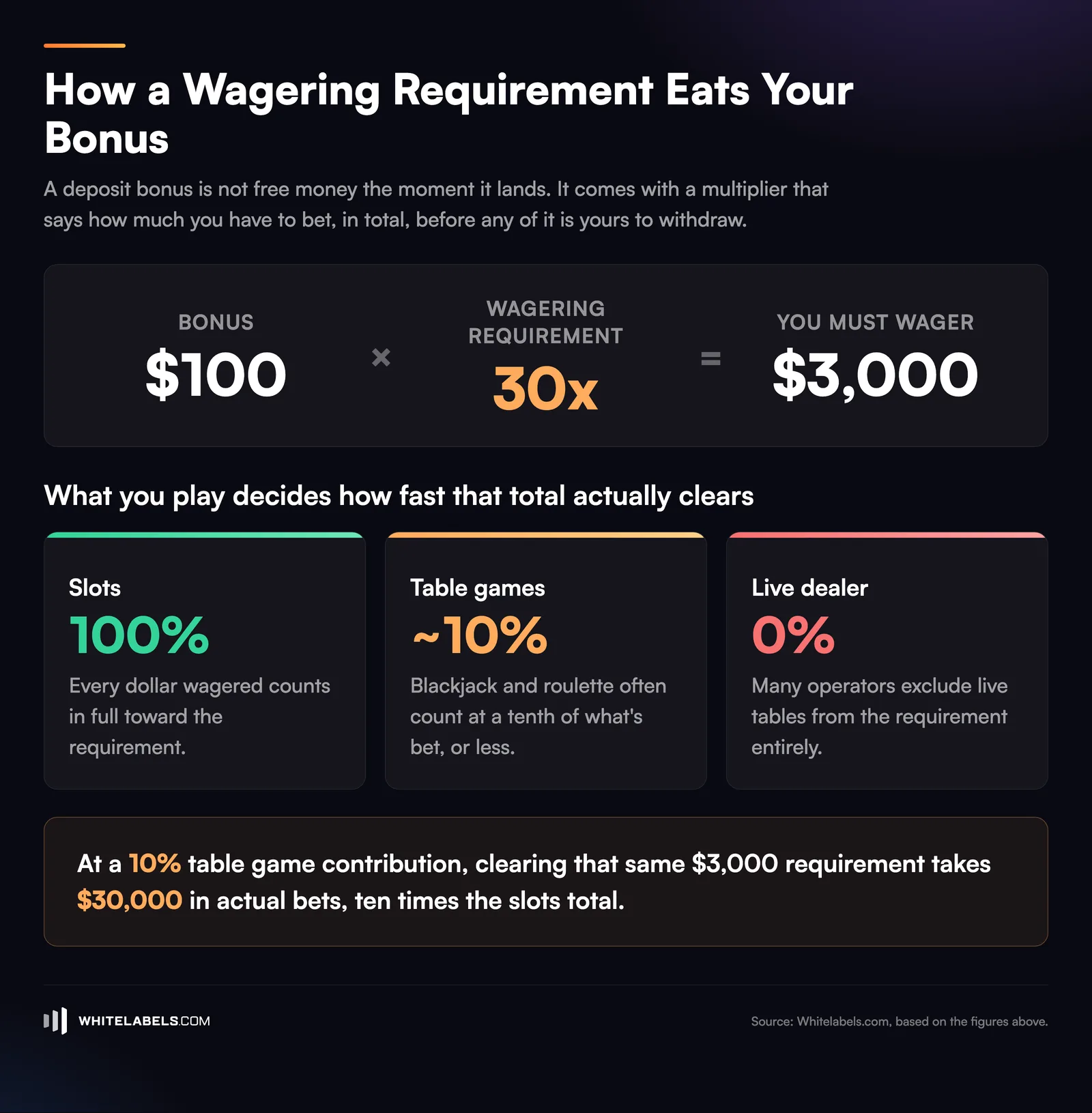
Multiply the bonus amount by the wagering requirement multiplier. A $100 bonus with a 30 times wagering requirement means placing $3,000 in total bets before any bonus winnings can be cashed out. That $3,000 does not need to come from one bet. It builds up across every wager placed while the bonus stays active, win or lose, until the running total reaches the target.
Wagering requirements commonly ran from 20 to 40 times the bonus before recent reform in the UK, and some operators set the number as high as 50 or 60 times. A 60 times requirement on that same $100 bonus works out to $6,000 in total bets, double the 30 times example above, for the exact same headline offer.
Why do casinos attach a wagering requirement to a bonus?
Without one, a bonus would amount to a straight cash giveaway. A player could claim a deposit match, withdraw the free money right away, and never place a real bet on the platform. A wagering requirement closes that gap. It forces the bonus back through the casino's games before it converts into cash a player can withdraw, which is also where the house edge on every game gets a chance to do its work. The requirement is what turns a marketing offer into money a player can win with, if the games go their way, rather than money that walks straight back out the door.
Why does the game you play change how fast a bonus clears?
Because casinos restrict which games count fully toward a wagering requirement, and the gap between games is large. Online slots typically contribute 100%, meaning every dollar wagered counts in full. Table games like blackjack and roulette often count for 10% of each bet or less. Live dealer tables are sometimes excluded from the requirement altogether, counting for 0%.
That gap exists because of house edge. Blackjack played with correct strategy can run a house edge under 1%, so if it counted in full toward a wagering requirement, a skilled player could clear the requirement while giving up very little of the bonus along the way. Slots generally carry a higher house edge, so operators can let them count in full without much cost to the house.
The practical effect is large. Clearing a $3,000 wagering requirement on slots takes $3,000 in bets. Clearing that same $3,000 requirement on a table game with a 10% contribution rate takes $30,000 in actual bets, ten times as much, because only a tenth of each wager counts toward the total.
How much does a wagering requirement really cost, in real bets?
Set your own bonus, multiplier, and game contribution rate below to see the gap for yourself.
See what a bonus really costs to clear
Set a bonus amount, a wagering multiplier, and how much the game you play contributes toward it. See the real total in bets.
Wagering target
$3,000
Real bets needed on this game
$3,000
Vs the UK's 10x operator cap
3.0x the cap
A $100 bonus at 30x sets a $3,000 wagering target. This game contributes at 100%, so $3,000 in real bets clears it.
This is a math illustration based on the multiplier and contribution rate you choose, not any specific operator's bonus terms. Planning illustration only, not gambling advice.
What did the UK Gambling Commission change about wagering requirements in 2026?
UK-licensed operators must now cap wagering requirements at 10 times the bonus amount, and they can no longer require a bonus to be cleared by playing more than one type of gambling product. The Gambling Commission announced both changes on 26 March 2025, and after pushing back its original 19 December 2025 start date by a month to give operators more time to prepare, the rules took effect on 19 January 2026.
The cap is a steep cut from where the market sat. Some operators had run wagering requirements as high as 50 or even 60 times the bonus. Under the new limit, a $100 bonus can require no more than $1,000 in total bets, well under the $3,000, $5,000, or $6,000 that older multiples demanded for the exact same offer. The Commission's stated reasoning is that high multiples confuse players and push them to gamble faster and longer than intended.
The second change targets a separate problem: bonuses that require a player to gamble across more than one type of product, such as pairing a sports bet with casino free spins, to qualify for a reward. The Commission's own evidence found that players face more risk gambling across multiple product types than sticking to one, so licensed operators can no longer structure an offer that way.
Both rules apply only to operators licensed by the UK Gambling Commission. A wagering requirement offered under a different jurisdiction's license is not bound by the UK's 10 times cap or its single-product rule, so the wider multiples described earlier in this article still show up on plenty of sites licensed elsewhere. For the fuller picture on what a UK license itself costs and requires, see our breakdown of the UK Gambling Commission license.
What's the bottom line on wagering requirements?
A wagering requirement decides how real a bonus turns out to be once the terms are applied. The multiplier sets the total amount a player has to bet before bonus winnings convert to cash, and the games played against that requirement can change the real cost by a factor of ten or more. Read the multiplier next to a bonus, check which games count and at what rate, and run the math before deciding whether an offer is worth claiming.
If you are building the platform players see these terms on, rather than claiming bonuses on one, the same numbers are configuration decisions: wagering multipliers, game contribution rates, and product eligibility are all levers you set. Whitelabels.com ships a casino games library with documented RTP and house edge on every title, so bonus mechanics rest on published numbers instead of guesswork. For the math sitting underneath every game's contribution rate, see what house edge means, and for the discipline that keeps any bankroll, bonus or not, from disappearing faster than planned, see how to manage a casino bankroll.
Key takeaways
- A wagering requirement (also called playthrough or rollover) is a multiplier on a bonus that sets the total amount a player must bet before any bonus winnings become withdrawable.
- A $100 bonus with a 30 times wagering requirement demands $3,000 in total bets before any of the bonus winnings can be cashed out.
- Game contribution rates change how fast that total clears. Online slots typically count 100% toward it, table games like blackjack and roulette often count 10% or less, and live dealer tables are sometimes excluded entirely.
- Since 19 January 2026, UK-licensed operators must cap wagering requirements at 10 times the bonus amount and cannot require a bonus to be cleared by playing more than one type of gambling product.
- The UK Gambling Commission announced these reforms on 26 March 2025, originally targeting a 19 December 2025 start date before pushing it back a month so operators had more time to prepare.
- Some operators had run wagering requirements as high as 50 or 60 times the bonus before the UK cap took effect, and jurisdictions outside the UK are not bound by the new limit.


